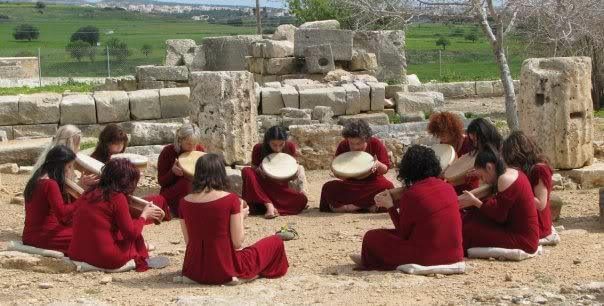
Imagine there is a place where, the moment you enter, softness meets you at the door.
The eyes that find yours are warm, curious, unguarded. One woman smiles in recognition, another makes space beside her, and no one asks you to become smaller before you are allowed to belong.
You are welcomed as you are, without being measured against anyone else in the room.
Something in your body begins to loosen. Your shoulders drop. Your breath deepens. You do not feel yourself disappearing into the room; somehow, you feel more present inside yourself because of it.
This is where the circle begins.
There are many ways to sit in a circle, and almost as many reasons for gathering there. Women have done it for longer than any of us can trace, bringing their bodies close enough to hear one another breathe, speak, grieve, laugh and remember. At its core, a Sacred Circle offers something both simple and increasingly rare: the opportunity to be held by other women in a way that women have always known how to hold one another.
And the shape is not incidental.
A circle does something no line can do. It refuses a beginning and an end, and gives no one the final position. It bends back toward itself without closing anyone out. Long before we gave it meaning in ceremony, it was already present in the movements by which life keeps time: in orbits, tides, seasons, rings in wood, the widening surface of water after something has touched it.
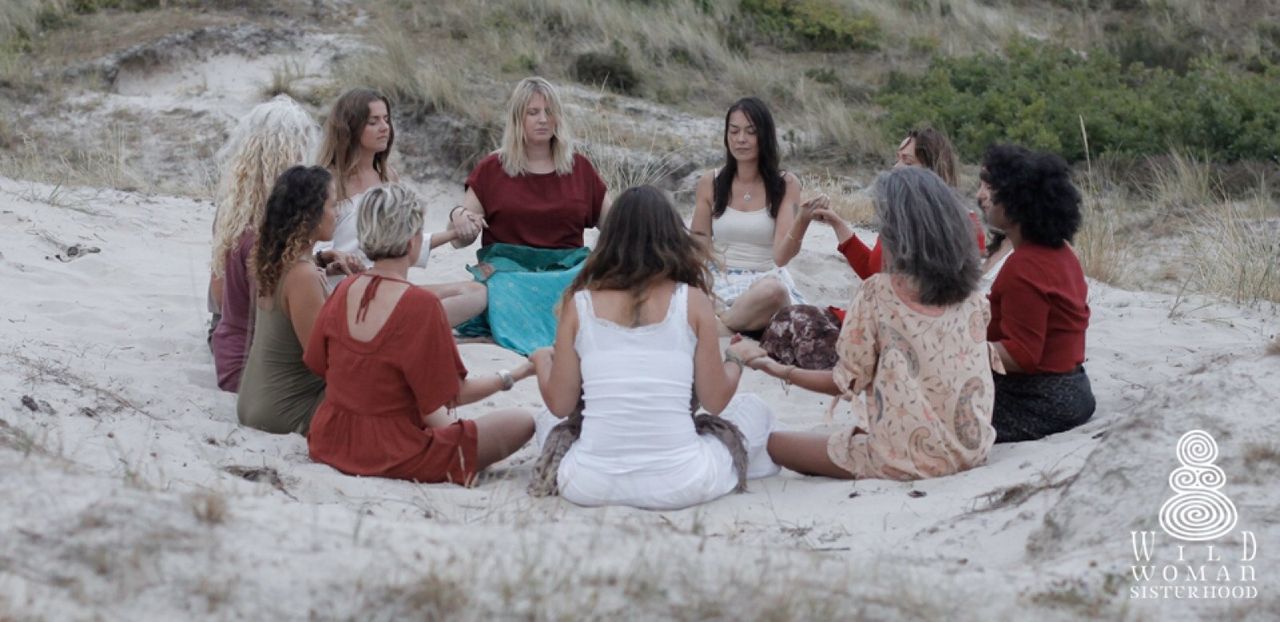
Its geometry carries the same strange generosity. Of all shapes with the same perimeter, the circle encloses the greatest space. Yet when women sit within one, that spaciousness can feel intensely intimate. A woman may travel an enormous distance there without ever leaving her seat.
This is part of what the ritual of Women’s Circles can do.
When we enter a sacred ceremonial circle that women before us have entered in countless forms, we are not recreating their lives, nor pretending there has ever been one universal women’s tradition. We are taking part in something more human than that: the old gesture of gathering close enough to listen well, to witness one another, and to make meaning together. Every circle is newly formed, yet the gesture itself has been repeated for generations.
Calling a circle sacred does not make it so. The women inside it do.
That begins with the way we receive one another. What is spoken is not immediately corrected, analysed or converted into advice. A woman is allowed enough room to finish her own thought, perhaps even to hear herself think while she is speaking. We listen without arranging our response in advance, and without trying to turn her experience into something more familiar to us.
Such listening is rarer than it sounds.
Outside the circle, women are constantly being measured against one another: by beauty, age, achievement, motherhood, money, desirability, confidence, productivity. Inside a true circle, those measurements begin to lose their authority. One woman may bring decades of experience, another a question she has only just learned how to ask, yet neither occupies a higher seat.
What each woman carries alters what becomes possible in the room.
A story placed into the center can touch something another woman has never been able to name. Her response may reveal an angle the first woman could not see from where she was standing, while someone across the circle recognizes a pattern neither of them had noticed. No single perspective has to become the truth of the room. An idea can remain in motion there, turning slowly as different lives illuminate it from different sides.
That is where the deeper power of Circle begins to show itself.
We arrive with our histories, inner voices, blind spots, wounds, intuition and ways of understanding the world. None of that disappears when we gather. It enters the room with us and begins to encounter the lives of other women.
Clarity does not always come because someone gives us an answer. Sometimes another woman speaks and something inside us suddenly shifts into focus. What felt entirely private reveals an unexpected echo in someone else; what we had taken for a universal truth turns out to belong very specifically to our own history. In that movement between recognition and difference, individual experience can open into something larger.
Some traditions might call what forms between women in such a moment a resonant field. Others might speak of Spirit, grace, collective consciousness, or simply the rare force of deep human attention. The name matters less to me than what happens: separate lives begin to illuminate one another without dissolving into sameness.
And throughout all of this, each woman remains responsible for listening to her own inner voice.
A Sacred Circle does not ask us to surrender our discernment to the group. It sharpens it. We learn to hear ourselves while other voices are present, to receive another woman’s wisdom without mistaking it for instruction, and to offer what we know without requiring anyone else to live by it.
This is how a circle becomes more than a gathering.
No woman stands above it, and no single voice can own its wisdom. What moves through the center has been shaped by every woman willing to bring something true into the room. By the time we rise, the chairs have not moved, the walls are where they were, and yet something has travelled.
The circle remains where it always was.
We are the ones who have gone somewhere.
Photos: via Pexels.