
There are books you keep on a shelf, and there are books that end up full of folded corners, pencil marks, old receipts used as bookmarks, and passages you return to because they have somehow kept changing while you were living your life. This is a book that became my Bible.
Its pages are filled with wolves, bones, forbidden rooms, old women, lost instincts, danger, hunger, creativity and the long road back to the parts of ourselves we were taught to distrust. Clarissa Pinkola Estés does not use these stories as decoration. She opens them carefully, almost bone by bone, and shows how much knowledge about women has been carried inside myth, fairy tale and family story.
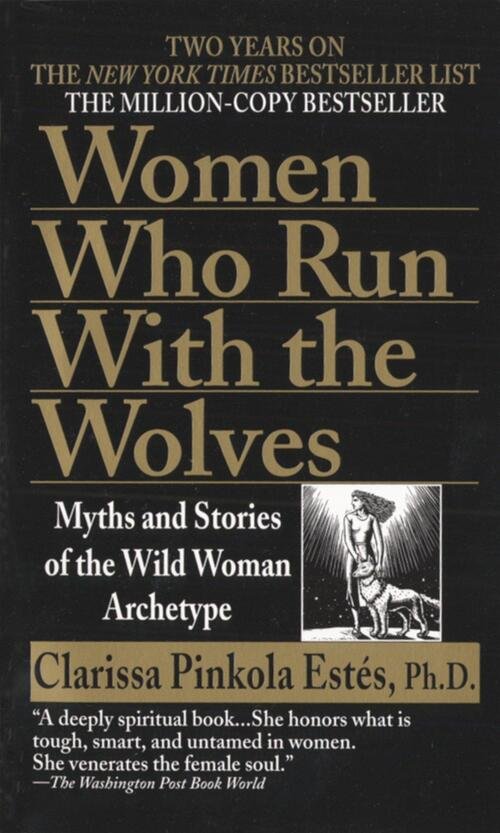
This book is called: Women Who Run With the Wolves
Author: Clarissa Pinkola Estés
She is a scholar, award-winning poet, senior Jungian psychoanalyst and cantadora, a keeper of the old stories in the Latina tradition. She calls the instinctual nature of women the Wild Woman: the part that senses, creates, protects, hungers, recognizes danger and knows when something vital is being starved.
That nature does not always disappear dramatically. More often, it gets pressed into smaller shapes. A woman learns to doubt the first thing she knew, to soften what she means, to stay longer than she should, to mistrust anger, appetite or the urge to make something that has no obvious use. The instinct is still there, but it can become difficult to hear beneath everything we have learned about how a woman ought to be.
Dr. Estés goes looking for it in stories.
She reads myths and fairy tales as places where women have been leaving clues for one another for generations. A tale may begin with a monster, a door, a forest or a bone, but the real question underneath is often much closer to home: what did she know, when did she stop trusting it, and what did it cost her?
The book first appeared in 1992, three years after she released the work as an audio program. It spent 145 weeks on the New York Times bestseller list and, according to the publisher, more than 2.7 million copies have been sold.
Those numbers explain its reach, but not its hold.
Women still pass this book to one another because it rarely stays politely on the page. A story can follow you into the kitchen, into a relationship, into an old memory you thought had finished with you. Sometimes a paragraph makes something obvious that you had been circling for years. At other times, you have to close the book because the story has come a little too close.
Maya Angelou said, "Everyone who can read should read this book." The San Francisco Chronicle called it "vitamins for the Soul," and the Los Angeles Times described it as a "Bible for women interested in doing deep work." Thomas Moore, author of Care of the Soul, wrote about the way the book reminds us that we are still wild, and how recovering that vitality can help set us right in the world.
For Wild Woman Sisterhood, this book has always lived close to the roots.
A book that we can recommend every woman that wants or needs to explore her wildest essence, a book which reveals the instinctual nature of woman. Within her lives a powerful force, filled with good instincts, passionate creativity, and ageless knowing.
Its deepest gift, for me, is that it does not invent the Wild Woman for us. It assumes she is already there. She may have been silenced, overruled, exhausted or pushed so far into the background that we barely recognize her anymore, but she has not vanished.
Read how her work shaped Wild Woman Sisterhood.
If you want to give a precious Gift to yourself or your sisters/ daughters.. This is it ~! ♥
Book: Clarissa Pinkola Estés, Women Who Run With the Wolves (Ballantine Books, 1992). Cover image: Ballantine Books.
Photos: Djulien via Pexels.